


Top Pageant Training in Pune for National & International Pageants

A pageant stage looks glamorous from the outside, but the real work starts months before the spotlight turns on. The walk, the smile, the introduction, the answer under pressure, the way a contestant enters a room, all of it adds up. Confidence is trained. Presence is shaped. Clarity is practised.

For aspirants preparing for platforms such as Femina Miss India, Miss Universe India, Miss Diva, Miss Teen Diva, Mrs India, and other national or international pageants, professional coaching can make a visible difference. In Pune, The Tiara Pageant Training Studio has built its name around this kind of all-round preparation.
Founded in 1997, The Tiara is led by International Pageant Coach Ritika Ramtri. Its approach focuses on complete contestant development, covering communication, ramp walk, personality, grooming, interview skills, camera presence, and the inner confidence needed to stand out with authenticity.
Why pageant training matters before the crown
Many contestants begin with one question: “Can I learn to walk like a pageant winner?” Ramp walk matters, but pageants test much more than movement.
Judges observe how a contestant carries herself from the first interaction. They notice posture, facial expression, voice, eye contact, confidence, listening skills, grooming, and emotional control. A strong contestant looks comfortable in her own skin even when the situation is intense.
That comfort rarely happens by chance. It comes from preparation.
Good pageant training helps an aspirant:
Understand her strengths and present them clearly
Replace nervous habits with poised body language
Answer questions with structure and honesty
Walk with balance, grace, and awareness
Build a personal introduction that sounds natural
Prepare for auditions, interviews, state rounds, and finals
Develop a meaningful advocacy or social-impact platform
The goal is not to create identical contestants. The best training brings out the contestant’s own personality and helps her express it with more polish.
That is where The Tiara’s approach stands out. It works on the individual, not just the outer presentation. A contestant does not need to sound rehearsed to sound prepared. She needs to sound clear, composed, and real.
What makes The Tiara a strong choice in Pune
The Tiara Pageant Training Studio has been part of the Indian pageant training space since 1997. That experience matters because pageant formats, selection rounds, and judging expectations have changed over the years.
Modern pageants look for a complete personality. Beauty still attracts attention, but substance holds it. Contestants are expected to speak well, think clearly, handle public questions, and present a point of view. They need to look polished on stage and remain grounded in conversation.
The Tiara’s training is built around this wider expectation.
Its founder and lead coach, Ritika Ramtri, is known as an International Pageant Coach. Under her guidance, the studio trains aspirants for national and global platforms, including Miss India, Miss Universe India, Miss Diva, Mrs India, Miss Teen Diva, and other competitions.
The training environment is especially useful for contestants who want structure. Many aspirants know they have potential, but they do not know what to practise or how to measure progress. A trained coach can spot small details that friends and family may miss, such as:
A stiff shoulder during a walk
A rushed introduction
A smile that drops too quickly
An answer that sounds vague
A posture habit that affects photographs
A lack of connection with the audience
These details can change the way a contestant is perceived. Pageant training helps refine them before the actual stage.
What you learn at The Tiara
The Tiara’s coaching covers the main skills needed across auditions, interviews, pageant rounds, and stage appearances. Each area supports the other. A better walk improves presence. Better communication improves confidence. Better grooming supports the overall impression.
Pageant and ramp walk training
The ramp walk is one of the most visible parts of pageant performance. It is also one of the most technical.
A confident walk includes posture, balance, rhythm, turns, pauses, and control. Contestants must understand how to move in different outfits, from gowns to traditional wear to cocktail looks. A walk that suits one outfit may not suit another.
Training usually focuses on:
Body alignment and posture
Foot placement and balance
Turns, pivots, and transitions
Posing at the right points
Walking with facial expression
Maintaining grace under pressure
Outfit-specific movement
A contestant also learns how to recover smoothly from small mistakes. If a turn is not perfect or a step feels unsteady, the audience should not see panic. That calm response is part of stage maturity.
The art of introductions
Introductions are short, but they carry a lot of weight. In 30 or 60 seconds, a contestant must share who she is without sounding memorised or generic.
A weak introduction lists facts. A strong introduction gives a glimpse of personality, purpose, and confidence.
At The Tiara, aspirants work on creating introductions that feel clear and natural. This includes choosing the right details, improving voice modulation, removing filler words, and learning how to end with impact.
A good introduction answers three silent questions:
Who are you?
What do you stand for?
Why should the judges remember you?
The answer does not need to be dramatic. It needs to be sincere and well delivered.
Interview and Q&A preparation
The interview round often separates prepared contestants from unprepared ones. A contestant may look confident on stage, but the interview reveals how she thinks.
Questions can be personal, opinion-based, situational, social, or rapid-fire. Some may test awareness. Others may test honesty and emotional balance. Preparation helps contestants respond without freezing or over-explaining.
Training may include:
Mock interviews
Rapid-fire practice
Opinion-based questions
Situational questions
Personal story development
Answer structure and timing
Voice and body language feedback
The aim is not to memorise perfect answers. Judges can usually sense when an answer is copied. The aim is to develop clarity of thought, so the contestant can answer naturally even when the exact question is unexpected.
A strong pageant answer is not the longest answer. It is the one that is honest, clear, and complete.
Stage presence and confidence
Stage presence is difficult to fake. It comes from alignment between body language, expression, voice, and self-belief.
Some contestants enter a room and instantly draw attention. Others have strong potential but appear hesitant. Training helps bridge that gap.
At The Tiara, stage presence work includes eye contact, expression, body language, voice control, and composure. A contestant learns to be aware of how she stands, how she listens, and how she reacts.
Confidence also grows through repetition. When a contestant has practised introductions, walking, posing, and answering questions many times, the stage feels less unfamiliar. She stops thinking about every small movement and starts enjoying the moment.
Grooming and styling guidance
Grooming is not only about makeup or clothes. It is about presenting a polished version of oneself while staying true to personal style.
For pageants, grooming includes:
Skincare and personal presentation basics
Hair and makeup awareness
Outfit selection and styling
Deportment and etiquette
Colour, fit, and occasion awareness
Understanding what works on stage and on camera
A common mistake is copying another contestant’s look. That can make a person appear uncomfortable. Good styling should complement body type, personality, age, and pageant category.
The Tiara’s grooming guidance helps contestants understand how presentation affects the overall pageant image. This is especially useful for aspirants who are new to professional shoots, stage lights, or formal pageant events.
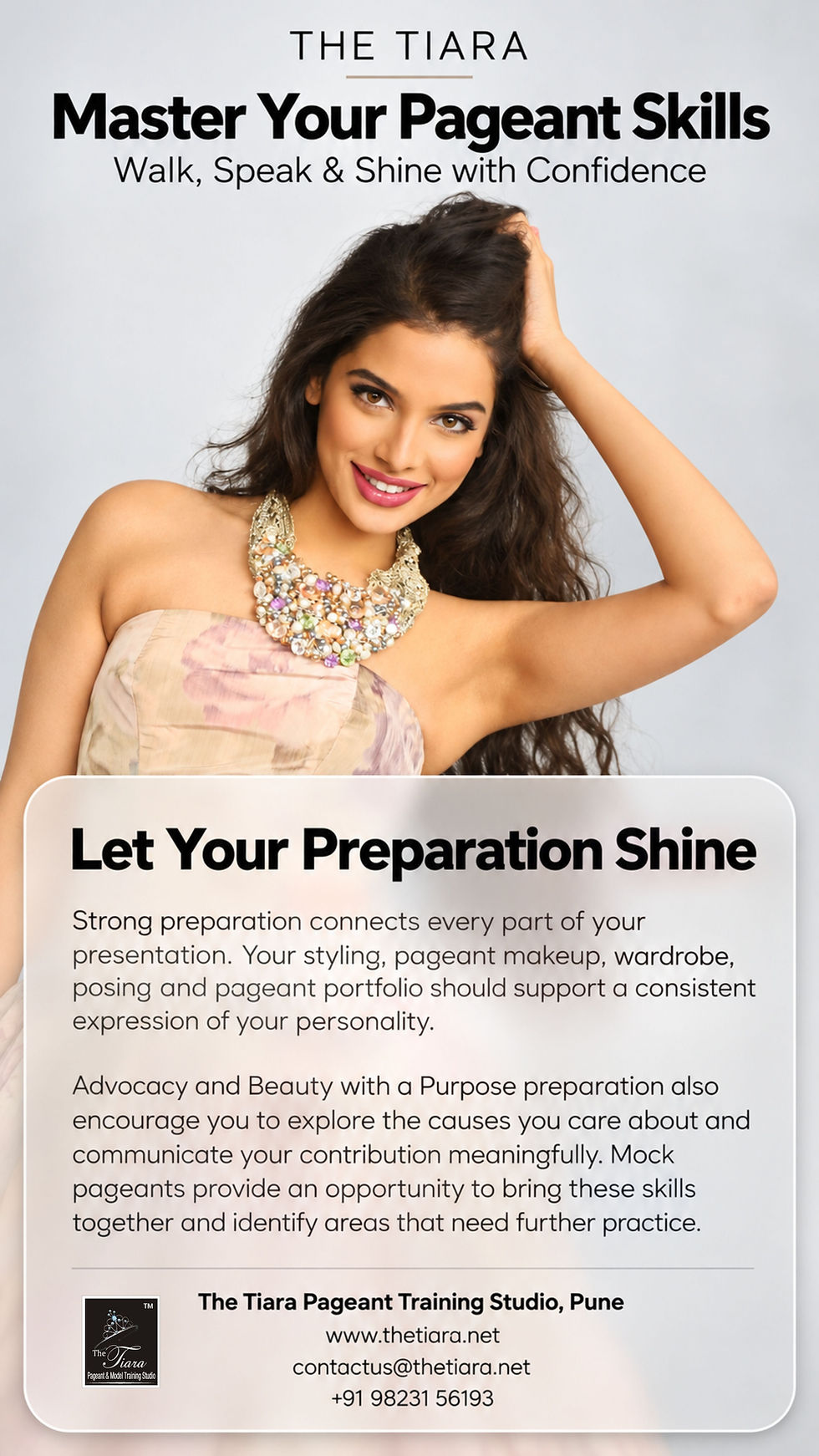
Advocacy and Beauty With a Purpose
Modern pageants value contestants who care about something beyond the crown. Many platforms ask aspirants to present a cause, advocacy, or social-impact idea.
This cannot be built overnight. A meaningful advocacy must feel credible. It should connect with the contestant’s values, lived experience, education, work, or long-term interest.
Training helps contestants shape this part of their profile thoughtfully. The focus is on clarity and sincerity. A contestant should be able to explain:
What cause she supports
Why it matters to her
What she has done or plans to do
How she can use the pageant platform responsibly
What impact she hopes to create
This preparation is useful for interviews, introductions, social-impact rounds, and public interactions.
Portfolio and camera training
A pageant portfolio is often the first impression before a contestant enters the room. Camera training helps aspirants understand angles, expressions, posture, and how to project personality through photographs and videos.
Many contestants feel comfortable in selfies but freeze in front of a professional camera. Training helps them learn how to pose without looking stiff.
Portfolio and camera work may include:
Face angles and expression control
Full-length and close-up posing
Hand placement
Movement for video introductions
Body awareness in still frames
Confidence in front of the lens
This matters because pageant applications, audition videos, and profile images must reflect polish and personality.
How structured coaching changes a contestant
The biggest benefit of pageant training is not one single skill. It is the combination of many small improvements.
A contestant who starts with raw potential may already have beauty, ambition, and a strong dream. Training gives that dream a method.
Here is how the change usually appears:
Before training | After structured coaching |
Walk feels uneven or self-conscious | Walk becomes balanced and graceful |
Answers sound rushed or unclear | Responses become organised and calm |
Introduction feels generic | Introduction reflects personality and purpose |
Camera posing feels awkward | Poses look more natural and confident |
Styling feels confusing | Presentation becomes more polished |
Nervousness takes over | Composure improves through practice |
This is why the Top Pageant Training in Pune for Confident Pageant Success is not only about preparing for one event. It helps build communication, self-presentation, and confidence that can support modelling, public speaking, media appearances, and personal growth as well.
Who can benefit from pageant training
Pageant coaching is useful for more than experienced contestants. Many aspirants begin with no formal background in modelling, dance, theatre, or public speaking.
Training can help:
First-time pageant aspirants
Miss India and Miss Diva applicants
Miss Universe India aspirants
Teen contestants preparing for youth pageants
Married women preparing for Mrs India platforms
Models who want stronger speaking skills
Students who want to build confidence
Professionals preparing for public-facing opportunities
The Tiara’s Pune-based studio attracts aspirants who want focused preparation for Indian and international platforms. Since pageants now require a mix of elegance, communication, awareness, and originality, early preparation gives contestants more time to improve.
How to prepare before joining pageant coaching
Aspirants do not need to arrive perfect. That is the point of training. Still, a little self-preparation can help make coaching more effective.
Before joining, it helps to:
Watch recent pageant interviews and introductions
Record a short self-introduction and review it honestly
Make a list of personal strengths and achievements
Think about one social cause that feels meaningful
Practise basic posture and walking awareness
Build a simple grooming routine
Stay open to feedback
The right mindset matters. Pageant training involves correction. A coach may point out habits that feel personal at first, such as voice tone, facial expression, or posture. The best contestants treat feedback as useful information, not criticism.
Progress comes faster when an aspirant stays consistent, curious, and willing to practise outside class.
What to look for in a pageant training studio
Choosing a pageant coach is a serious decision. The training should make a contestant more confident, not more confused.
A good pageant training studio should offer:
Experience with recognised pageant formats
Individual feedback instead of only group instruction
Training in both walk and communication
Grooming and styling guidance
Mock interviews and Q&A practice
Support for introductions and advocacy
Camera and portfolio preparation
A respectful learning environment
The Tiara fits this need because its work goes beyond ramp walk. It focuses on total stage and personality development, which is essential for serious aspirants.
For someone aiming for national pageants, piecemeal preparation can leave gaps. A contestant may have a great walk but weak answers, or strong communication but poor stage movement. Complete training brings everything together.
FAQ
Is pageant training necessary for Miss India or Miss Universe India preparation?
It is not compulsory, but it can be very useful. Pageant training helps aspirants prepare for walking, interviews, introductions, grooming, styling, confidence, and stage presence in a structured way.
Can beginners join The Tiara Pageant Training Studio?
Yes. Pageant coaching is suitable for beginners as well as experienced contestants. A good training programme starts with the contestant’s current level and builds from there.
What skills are most important in a beauty pageant?
Important skills include confidence, communication, posture, ramp walk, grooming, camera presence, emotional control, and the ability to answer questions clearly under pressure.
How early should an aspirant start pageant training?
Starting early gives more time to improve. Many contestants benefit from beginning months before auditions or applications, especially if they need work on communication, walk, styling, or confidence.
Does pageant training only help with competitions?
No. The skills can help beyond pageants too. Communication, self-presentation, poise, camera confidence, and public speaking are useful in modelling, media, interviews, events, and professional life.
Step onto the stage with preparation and purpose
Pageant success is built through discipline, self-awareness, and the right guidance. A crown is won on stage, but the foundation is created through months of practice, correction, and personal growth.
The Tiara Pageant Training Studio in Pune offers this kind of preparation for aspirants who want to compete with confidence. With training in ramp walk, introductions, interviews, grooming, styling, advocacy, and camera presence, contestants learn how to present themselves with polish and authenticity.
The stage rewards more than beauty. It rewards preparation, presence, and purpose. For aspirants ready to take pageantry seriously, the right coaching can turn potential into performance.
www.thetiara.net | contactus@thetiara.net | +91 98231 56193


Comments