


Pageant Training in India for Confidence, Grace and Winning Presence

A pageant contestant can have the perfect outfit, glowing skin, and a polished introduction, yet still lose impact the moment she walks into the room. Judges notice much more than beauty. They notice posture, energy, clarity, confidence, recovery after a mistake, and the ability to express a real personality under pressure.
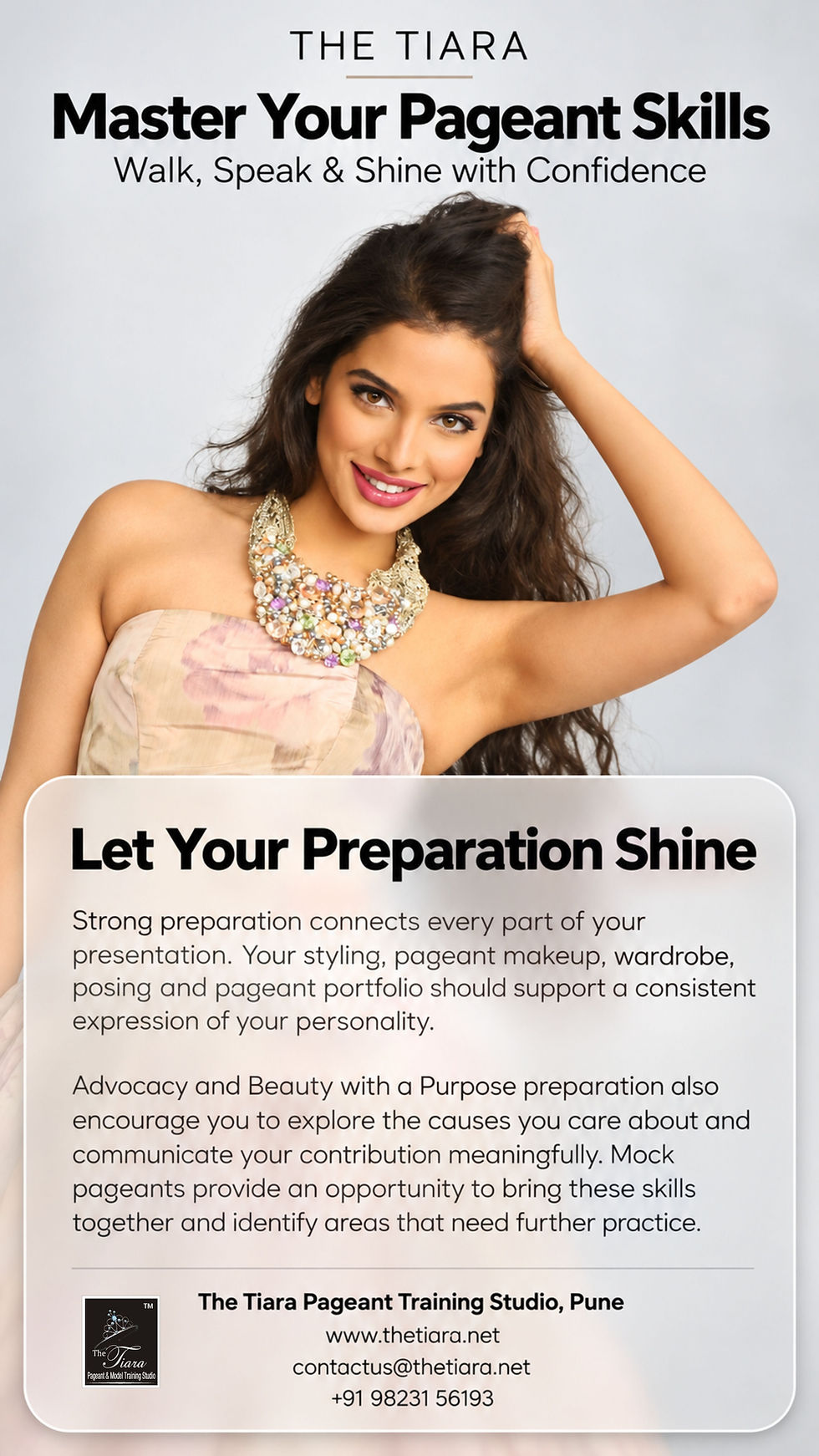
That is where focused pageant training makes a difference.
For aspirants preparing for Femina Miss India, Miss Universe India, Miss Teen Diva, Miss Grand India, Miss Diva, Miss Teen India, Miss Earth India, Mrs. India, and future pageant seasons from 2027 to 2030, preparation cannot be limited to appearance. The strongest contestants understand how to carry themselves, speak with purpose, and stay centred when the spotlight is on them.
The Tiara, based in Pune, trains pageant aspirants to bring out that complete presence. The goal is not to create a copy of someone else. The goal is to help each contestant express her own personality with confidence, grace, and professionalism.
Pageant success begins before the spotlight
Many contestants begin with the visible parts of preparation. They work on fitness, styling, grooming, skincare, and outfits. These matter, but they are only one part of the pageant journey.
The bigger challenge often appears in moments that cannot be fixed by styling alone:
Walking with control on stage
Sitting with poise during an interview
Speaking clearly without sounding rehearsed
Answering questions under pressure
Showing warmth without appearing nervous
Recovering gracefully after a pause or mistake
Standing out without trying too hard
These are skills. They can be taught, practised, and refined.
A pageant is a performance, but it is also a personality test. Judges want to see whether a contestant can represent herself, a cause, a title, and often a larger platform. That requires more than attractive presentation. It requires presence.
Presence is the combination of body language, voice, composure, and authenticity. When these come together, a contestant does not need to push for attention. She naturally holds it.
Why posture changes the way judges see you
Posture is one of the first signals a contestant sends. Before she speaks, her body has already introduced her.
A slouched shoulder can make even a strong contestant appear unsure. A stiff walk can make confidence seem forced. A restless seated posture can distract from an otherwise thoughtful answer. On the other hand, a well-trained posture creates elegance, calmness, and authority.
The Tiara focuses on walking, sitting, and standing with a refined posture so contestants learn how to command the stage and remain poised during interviews.
This training is not just about “walking straight”. It includes:
Body alignment
Shoulder placement
Head position
Controlled arm movement
Balance in heels
Smooth turns
Stage entry and exit
Seated interview posture
Natural hand placement
Eye contact while moving
The difference is visible. A trained contestant looks lighter, calmer, and more in control. Her walk has rhythm. Her stance has purpose. Her smile does not look disconnected from her body language.
Posture also affects how a contestant feels. When the body is aligned and open, breathing improves. Movement becomes easier. Nervous energy settles faster. That physical control can support mental control during important pageant moments.
A strong stage presence is built through repetition, correction, and awareness. Confidence grows when the body knows what to do.
Grace is a skill, not a fixed personality trait
Some people believe grace is something a contestant either has or does not have. In pageantry, grace can be developed through disciplined training.
Grace shows in small details. It appears in how a contestant turns, pauses, smiles, listens, exits, and responds. It shows in the way she accepts attention without appearing overwhelmed by it.
A graceful contestant does not rush. She allows each movement to finish. She looks comfortable in her space. Even when she is nervous, she has trained habits that support her.
Good pageant training teaches contestants to become aware of their natural patterns. For example:
Walking too fast because of nerves
Smiling only with the lips, not the eyes
Looking down after answering a question
Moving hands too much while speaking
Standing with the weight unevenly placed
Sitting too stiffly during interviews
Speaking softly at the end of sentences
Once a contestant sees these habits, she can improve them. This is where professional correction helps. Friends and family may say “be confident”, but a pageant coach can show what confidence looks like in the body, step by step.
The aim is not to remove individuality. A contestant’s unique style should remain intact. Training simply helps that style become cleaner, stronger, and more pageant-ready.
Speaking well can set you apart from the crowd
Looks may attract attention, but words can create lasting impact. Every major pageant expects contestants to communicate. Personal introductions, interviews, on-stage questions, media interactions, and informal conversations all reveal how clearly a contestant thinks and speaks.
For many aspirants, this is the most difficult part. They may have strong opinions, meaningful life stories, and sincere goals, but struggle to express them in a polished way.
Effective pageant communication is not about using complicated English or memorising impressive lines. It is about clarity, sincerity, structure, and energy.
A strong answer usually has:
A clear opening thought
A personal connection or example
A confident point of view
A graceful closing line
The Tiara helps contestants speak with clarity and enthusiasm, using words that help them stand out without sounding artificial. This is especially useful for contestants preparing for pageants where interviews and question rounds carry serious weight.
The best answers sound prepared but not memorised
Memorised answers often fail under pressure. If the question changes slightly, the contestant may freeze. If the delivery sounds too rehearsed, judges may not feel a real connection.
A better approach is to train thinking patterns. Contestants learn how to listen to a question, organise a response quickly, and answer with calm confidence.
For example, a question about women’s leadership can be answered through:
A short belief statement
A real-life example
A connection to the contestant’s own journey
A hopeful and practical ending
This structure gives support without making the answer sound robotic.
Voice and expression matter as much as content
A good answer can lose power if the voice is flat. Another answer may feel strong because the contestant speaks with warmth, variety, and conviction.
Training often includes:
Breath control
Voice projection
Pace and pause
Pronunciation
Listening skills
Facial expression
Interview etiquette
Confidence in English and stage communication
This matters far beyond pageants. The same skills help in college interviews, career opportunities, public speaking, anchoring, modelling assignments, auditions, and leadership roles.
Stress control can change your entire performance
Every contestant feels pressure. The difference lies in how she handles it.
Pageant pressure can come from many directions. There are fittings, rehearsals, travel, comparisons, social expectations, family hopes, and the fear of making mistakes. Even talented contestants may underperform if stress takes over.
Stress control is not about pretending to be fearless. It is about learning techniques that help the body and mind stay steady.
A pageant training programme may include methods such as:
Controlled breathing before going on stage
Visualisation of the walk or interview
Grounding techniques for anxious moments
Positive self-talk
Practice under simulated pressure
Recovery techniques after a mistake
Building comfort with being watched
These tools help contestants access their training when it matters most. A calm contestant listens better, walks better, speaks better, and connects better.
Composure is one of the strongest signs of pageant readiness. Judges understand that contestants are under pressure. They notice who remains present despite it.
What a complete pageant training journey should include
A serious pageant journey needs a balanced mix of outer polish and inner strength. The best preparation brings together movement, communication, styling awareness, interview readiness, and emotional control.
Here is how a complete approach supports a contestant.
Training area | What it develops | Why it matters |
Ramp walk and stage movement | Balance, rhythm, confidence, entry and exit | Helps create a strong first impression |
Posture and poise | Body alignment, elegance, seated presence | Supports interviews, photoshoots, and stage rounds |
Communication skills | Clear speech, strong answers, expressive delivery | Helps judges understand the contestant’s personality |
Interview preparation | Listening, thinking, answering under pressure | Builds confidence for personal and panel interactions |
Stress control | Calmness, focus, recovery after mistakes | Helps performance remain steady |
Personality development | Authentic expression, self-awareness, confidence | Helps the contestant stand out naturally |
Pageant Training in India for Confidence, Grace and Winning Presence is especially valuable because contestants often need guidance that understands both Indian pageant expectations and international standards. The Tiara’s focus on poise, speaking skills, stagecraft, and self-expression supports aspirants who want to compete at a high level.
Why location should not stop serious pageant aspirants
The Tiara is based in Pune, but pageant dreams are not limited by city boundaries. Aspirants travel from across India when they find the right training environment.
Contestants from Delhi, Mumbai, Kolkata, Bengaluru, Guwahati, Indore, Jaipur, Goa, Nagpur, Bhopal, NCR, Gurugram, Chandigarh, Darjeeling, and other cities can benefit from expert pageant guidance without letting distance become a barrier.
For many aspirants, travelling for training is part of taking the goal seriously. A focused training period away from everyday distractions can help a contestant give full attention to her preparation.
The brief also matters for families. Parents or guardians often want to know whether the training location is practical and manageable. Assistance with accommodation can make the process easier for outstation participants, especially those planning in advance for future pageant cycles.
If a contestant is preparing for 2027, 2028, 2029, or 2030 pageant opportunities, early training can be a major advantage. Pageant skills develop over time. The earlier a contestant learns correct posture, communication habits, walk technique, and stress control, the more natural they become.
The Tiara approach focuses on the person behind the contestant
Every contestant has a different starting point. Some are comfortable on stage but struggle with interview answers. Some speak well but need help with walk and posture. Some look confident in photos but feel nervous in front of judges. Some have strong ambition but lack direction.
A good pageant coach does not treat every contestant the same. The training must identify what needs correction and what already makes the contestant special.
The Tiara specialises in bringing out each aspirant’s passion for pageants and raising it to a higher level of proficiency. This matters because pageant preparation can feel confusing without expert guidance. Contestants may spend time on the wrong things while missing the skills that judges actually notice.
The core focus includes:
Exquisite posture for walking, sitting, and standing
Poise and stage presence
Interview confidence
Clear and enthusiastic speaking
Use of impactful words
Stress control techniques
Professional pageant behaviour
Authentic personality expression
This kind of preparation supports not only pageant success but also long-term personal growth. Confidence, communication, body language, and self-discipline remain useful in any career a contestant chooses.
Preparation for major Indian and international pageant paths
India has a strong culture of pageantry, with many aspirants aiming for national and international platforms. Whether the goal is Femina Miss India, Miss Universe India, Miss Diva, Miss Grand India, Miss Earth India, Miss Teen Diva, Miss Teen India, Mrs. India, or another recognised pageant, the level of preparation must match the competition.
Each pageant has its own format and expectations, but the core qualities remain similar:
A contestant must look polished.
She must move with elegance.
She must speak with confidence.
She must show awareness of herself and the world.
She must handle pressure with maturity.
She must leave a memorable impression.
Training helps bring these qualities into daily practice. It also helps contestants avoid last-minute panic. A pageant should not be the first time an aspirant learns how to answer a personal question, walk in heels under observation, or hold eye contact with a judging panel.
The more a contestant practises in a guided environment, the more natural her performance becomes.
How to know you are ready for pageant training
The right time to begin is often earlier than most contestants think. A contestant does not need to be “perfect” before joining training. In fact, training is where rough edges are refined.
Pageant coaching can help if any of these feel familiar:
You feel nervous while speaking in front of people.
You are unsure how to introduce yourself.
You do not know how to walk or pose with confidence.
You receive compliments on your looks but struggle to express your thoughts.
You want to compete but do not know where to begin.
You have attended auditions but did not feel fully prepared.
You want professional guidance instead of random advice.
You are serious about future pageants in 2027, 2028, 2029, or 2030.
Readiness begins with willingness. If a contestant is ready to practise, accept correction, and grow, training can shape her into a far more confident version of herself.
Limited seats make early planning important
Focused pageant training works best when each contestant receives personal attention. That is why limited seats matter. A crowded training environment may not give enough correction for posture, walk, speech, and interview style.
For serious aspirants, early reservation helps in two ways. It secures a place in the programme, and it gives enough time to plan travel, accommodation, wardrobe, and preparation goals.
The Tiara in Pune welcomes contestants from across India and offers assistance with accommodation for outstation aspirants. Those who are committed to pageant preparation should not allow geography to decide the size of their dream.
To enquire or reserve a spot, contact The Tiara at www.thetiara.net, contactus@thetiara.net, or +91 98231 56193.
Pageant success is built before the crown is placed. It is built in posture drills, voice practice, interview correction, stress control, and the courage to express a unique personality with grace. With the right training, a contestant can walk into a room and show not only that she looks prepared, but that she is prepared.


Comments